
As we enter 2026, we have taken a deeper dive into the changes in the rental landscape throughout the year of 2025 and what has changed over the past year.
This end of year index is formed from a large dataset of over 119,000 individual renters.
This report provides the net rent-to-income ratio of UK renters – put simply, what percentage of their take-home salary is spent on rent. Our index includes average rent prices, calculated by the personal share paid by each renter instead of the overall average rental price of the property. This data is combined with the average income of those same renters to provide an accurate ‘rent-to-income ratio’ of each tenant.
The rule of thumb is that 50%of your take home pay should be spent on ‘needs’, which includes rent, but also utilities, food, travel, childcare, insurance, and minimum debt payments.Worryingly, in some areas in the UK, tenants are spending over half of their take-home pay on rental costs, taking them above the 50% spent on ‘needs’ guideline which is seen as affordable.
The Average Rent to Income Ratio in the UK is 41%
At a national level, the average UK renter spent 41% of their take-home pay on rent in 2025. The personal share of rent averaged £10,580 over the year (£882 pcm). Comparing this to our end of year 2024 rental affordability index, the rent-to-income ratio has increased by 5%, from an average of 36%, and the personal share paid by each renter is up by £684 (6.9%).
In the last year, the national average net income increased from£27,710 per year to £28,810.
A number of regions in the UK have the average tenant going beyond the 40% mark and up towards spending half of their money on rent, with London continuing to take top spot for the least affordable region.
Tenants in London are spending 48% of their take-home salary on rent, even despite boasting the highest average income at £37,600. Following closest behind is the South East, with a 44% rent-to-income ratio.
The North East offers the most affordable rent, with an average rent-to-income ratio being a third of their take-home salary (34%), andYorkshire and The Humber is just above at 35%.
Full regional breakdown
1. London: 48%
2. South East: 44%
3. East of England: 42%
4. South West: 41%
5. East Midlands: 38%
6. West Midlands: 38%
7. North West: 37%
8. Scotland: 37%
9. Wales: 37%
10. Yorkshire and The Humber: 35%
The rent-to-income ratio of each region has either increase or stayed the same, showing a trend that 2025 renting has become more unaffordable UK wide.
London rent becomes even more unaffordable in 2025
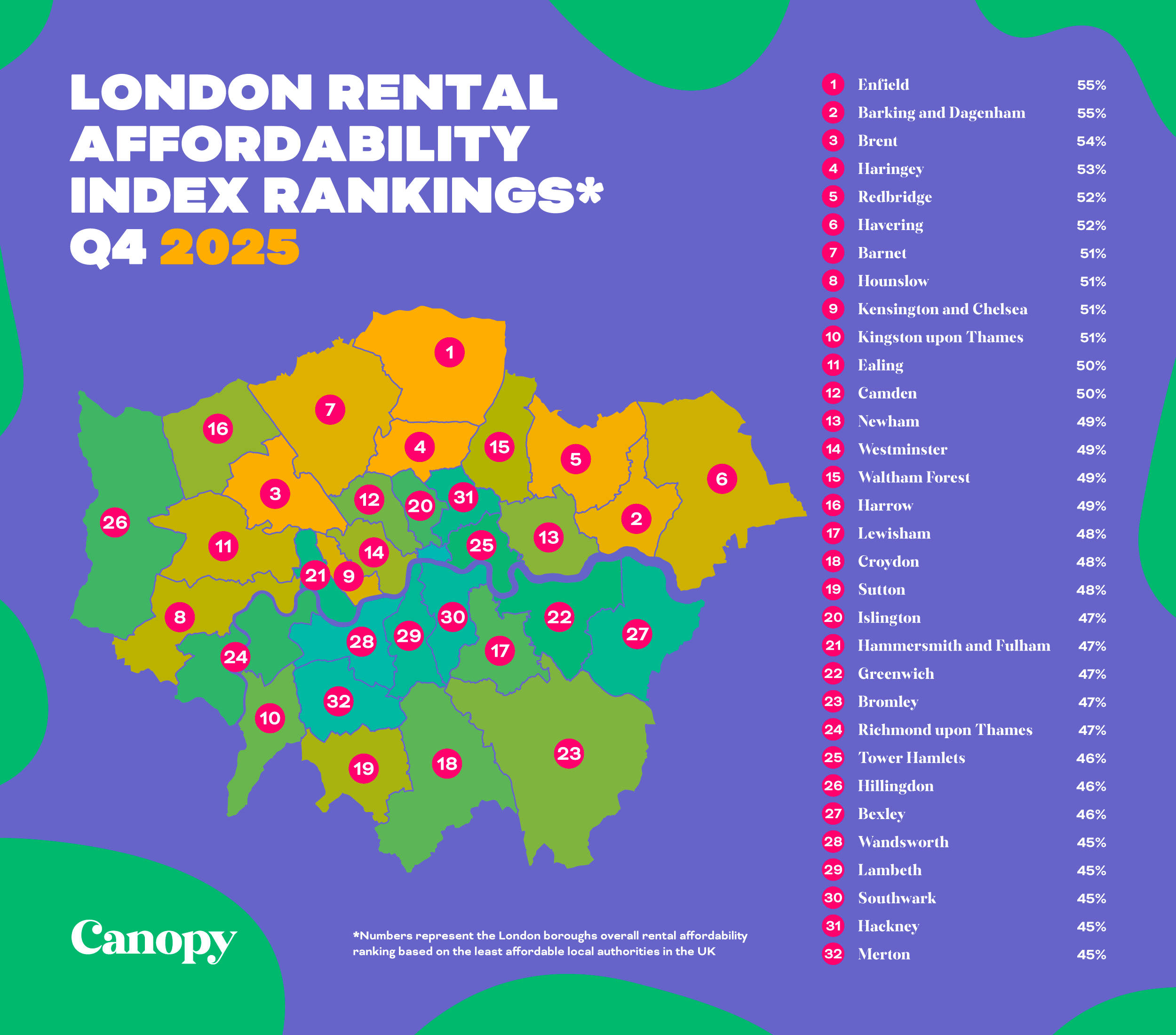
We analysed the average rental costs and salary data for tenants in all of London’s 32 boroughs.
The average London tenant spent £15,684 on rent in 2025, a10% increase from the £14,248 average in 2024. The average rent-to-income ratio is nearly half of a Londoner’s net salary (48%), much higher than the UK-wide average. All London boroughs exceeded the critical 40% recommended affordability threshold.
In 12 London boroughs, tenants spent over half of their 2025 earnings on rent. One year ago, there were only three London boroughs that had an average rent-to-income ratio of 50% or above – meaning the rental affordability problem in the capital is only worsening.
Enfield (55%), Barking and Dagenham (55%), and Brent (54%)topped the list as the least affordable boroughs, where tenants sent most of their take-home pay to their landlord.
The lowest rent-to-income ratio was recorded in Merton, but even here, renters spent 45% of their salary on rent, still well above the national average.
Where are the least affordable cities to rent in the UK?
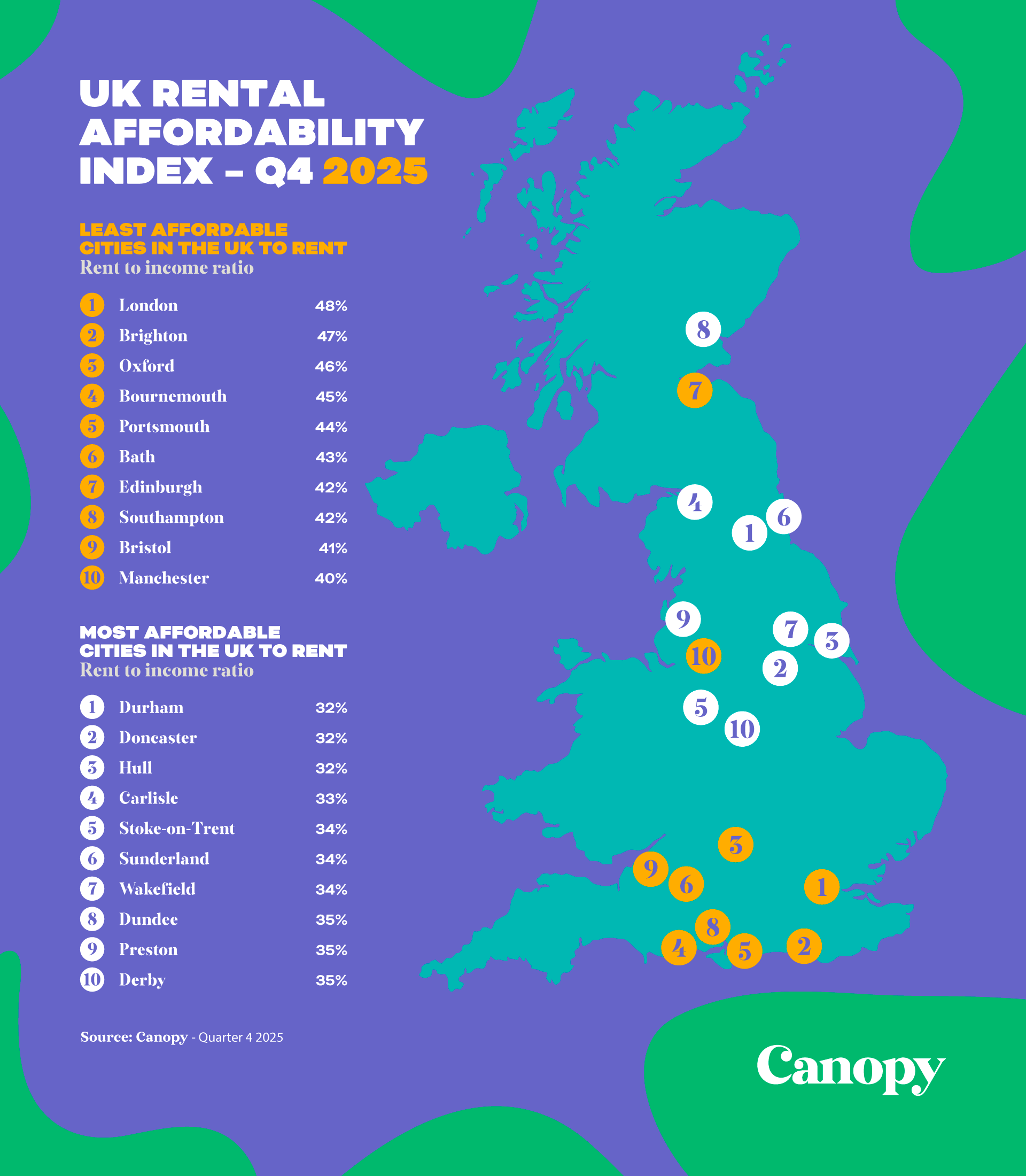
The south of England dominates the list of the least affordable cities, but not as much as it did in 2024. The top ten highest rent-to-income ratios are mostly located in the South of England; however,Edinburgh and Manchester are now in the top 10 least affordable cities to rent in the UK.
Renters in these cities are spending a significantly higher proportion of their salary on rent compared to the rest of the UK.
Outside of London, Brighton has overtaken Bournemouth as the least affordable city in the past year, with tenants spending 47% of their income on rent.
Most affordable cities in the UK to rent (lowest rent-to-income ratio):
In contrast, tenants in northern cities enjoy more manageable rent-to-income ratios.
Durham emerged as the most affordable city, with Doncaster and Hull following closely behind, with renters in all three spending just ~32%of their income on rent.
Half of Young adults' wages are being spent on rent
Our 2025 data found that for a young adult (aged 18-25), on average half (50%) of their net pay is going straight to their landlord, making rental affordability a challenge from the start of professional careers. This leaves little room for other essential costs like other household bills, weekly food shops, and social activities. Saving for a future house deposit is becoming increasingly difficult due to the current rental market.
For those aged 26-45, the average rent-to-income ratio improves by 10 percentage points as wages increase, but 40% of take-home salary is still in the outer limit of rental affordability.
Charlotte Benson, Customer Operations Manager at Canopy, commented: “Rental affordability has remained a challenge for most tenants in the year of 2025, with our data highlighting how the percentage of take-home salary being spent on rent has increased across the nation.
“On average, renters are now spending an average of 41% of their take-home salary on rental payments. Tenants are being stretched to the outer limits of rental affordability as financial strain continues, and in certain areas the situation is becoming even more severe.
“Unfortunately, with high demand, limited supply, and stagnant wage growth, rental affordability has not improved in the past year, particularly in the southern and highly urban areas.
“A third of London Boroughs are seeing renters pay over half of their salary towards rent, even before other essential payments are accounted for – creating an unsustainable situation. Despite these challenges, renting remains the only viable option for many who are priced out of homeownership.
“The positive light coming out of2025 is the Renters’ Rights Act, with key changes set to come into effect from1st May 2026. The aim to make rent fairer and more accessible, as rental bidding above the asking price becomes a thing of the past and landlords will only be able to raise rents once per year, and only in line with the market rate.
“After a tough 2025, these changes will hopefully see improvements in rental affordability across the UK in 2026.”
Read more on how to make the most of your finances
The 2025 index findings show that rental affordability is a continuous challenge for many tenants UK-wide, but we’re here to help both tenants and landlords tackle this alongside other issues that the UK rental property market can bring.
Our RentPassport provides a digital footprint that can take the hassle out of the process for renters, helping make tenant referencing smoother for letting agents and landlords.
Next time you move, all you need to do is show letting agents and landlords your RentPassport, which shows your previous rent history and helps demonstrate your affordability.
Check out our resources page for more information and advice on all things rent.
.png)
.png)